

How do you reach audiences in a city where people rarely commute to a single downtown core? San Diego’s outdoor advertising environment operates differently than traditional metro markets. The region functions as a distributed network of coastal communities, inland neighborhoods, employment hubs, military installations, universities, and event-driven zones spread across 372 square miles.
Static billboards capture exposure at fixed freeway points along I-5, I-8, and I-15, but they miss the surface-street circulation where San Diego’s 1.4 million residents actually spend their time. Daily movement patterns involve neighborhood errands, coastal recreation, local dining, university travel, and community events rather than predictable nine-to-five commutes to a concentrated downtown.
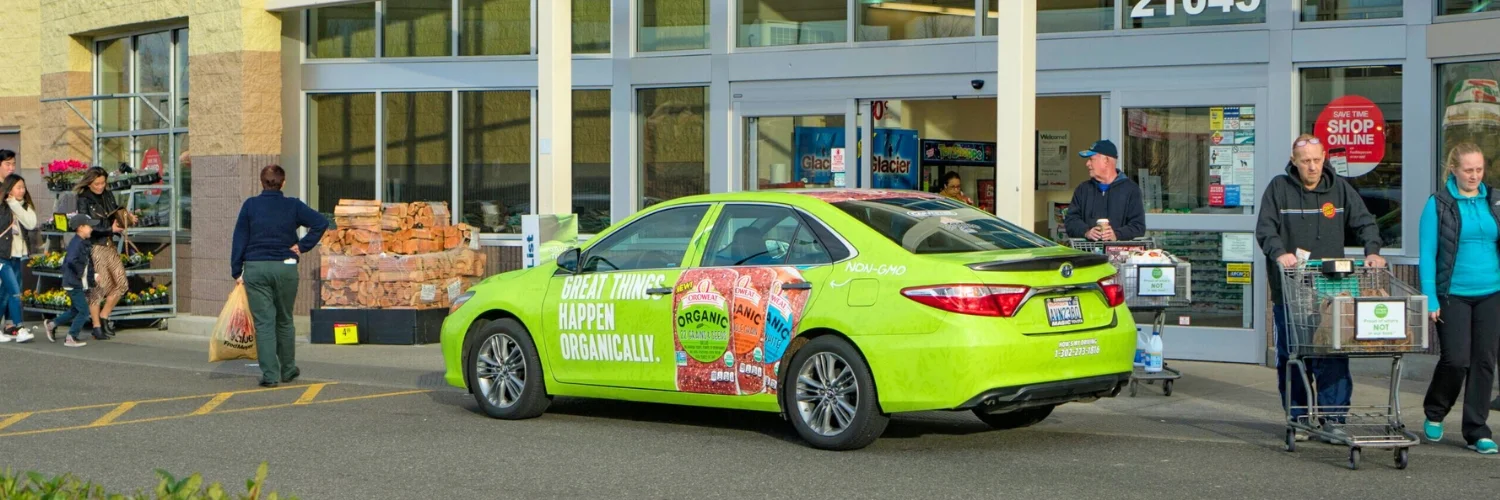
Mobile advertising with wrapped vehicles operates within these distributed movement patterns, circulating through neighborhoods, commercial corridors, parking areas, and surface streets where repeated exposure builds familiarity over time. Instead of waiting for audiences to pass a single location, mobile campaigns integrate into the daily routines that define how San Diegans actually navigate their region.
Understanding San Diego’s Outdoor Advertising Market
San Diego doesn’t function like cities built around dominant downtown cores. According to San Diego planning data, the region comprises multiple semi-independent neighborhood hubs, each with distinct commercial districts, employment centers, and cultural identities.
Mobile advertising through Carvertise’s network addresses this geographic fragmentation by deploying wrapped vehicles that circulate through multiple neighborhood ecosystems. Rather than concentrating impressions at isolated freeway choke points, campaigns build distributed visibility across the communities where target audiences actually frequent businesses, make purchasing decisions, and engage with local commercial environments.
According to demographic data, San Diego’s population is relatively young (median age 35.6 years) with significant military presence, university populations, and coastal tourism activity. These audiences move through the region in patterns that don’t conform to traditional commuter models, making distributed, neighborhood-level exposure increasingly relevant for effective outdoor advertising.
How Mobile Advertising Works in San Diego

Mobile outdoor advertising relies on an operational framework that connects route planning, vehicle circulation, GPS verification, and impression modeling. This framework supports alignment with observed movement conditions instead of assumed traffic flows.
Route planning emphasizes surface streets alongside major corridors. While freeways carry high volumes, much of San Diego’s daily circulation occurs on neighborhood arterials, coastal routes, and commercial district connectors.
Carvertise campaigns are designed around natural circulation patterns including residential neighborhood routes, shopping center access roads, coastal recreation corridors, university and military base approach streets, and downtown surface street grids.
Vehicle circulation creates repeated exposure through familiar environments. Unlike billboards that audiences pass once during specific trips, wrapped vehicles appear multiple times across different contexts: morning coffee runs, grocery store visits, beach parking areas, restaurant districts, fitness center lots, and evening entertainment zones. This repetition builds familiarity in contextually relevant settings rather than delivering isolated impressions during highway segments.
GPS Verification and Route Documentation
GPS verification provides accountability through route documentation. Partnership with StreetMetrics enables verification of routes driven, time spent in target neighborhoods, circulation consistency across campaign periods, and geographic distribution patterns. This transparency reduces reliance on estimated traffic counts at fixed billboard locations.
Impression modeling accounts for San Diego-specific factors including traffic conditions that increase exposure time, route density in target commercial areas, dwell time in parking and congestion zones, and frequency of repeated encounters. According to third-party industry research, wrapped vehicles are associated with high recall rates among transit advertising formats.
The strategic distinction becomes clear: mobile advertising accumulates exposure through distributed repetition in contextually relevant environments, while static placements concentrate visibility at single points along limited corridors.
Major San Diego Events That Shape Mobile Advertising Exposure
San Diego’s event calendar creates predictable traffic pattern disruptions that mobile advertising naturally integrates with. Major events don’t just generate attendance—they reshape circulation across wide geographic areas, creating distributed exposure opportunities.
San Diego Comic-Con
Comic-Con creates multi-day downtown congestion every July, drawing over 130,000 attendees. But visibility opportunities extend far beyond the convention center. Surface streets throughout downtown, the Gaslamp Quarter, East Village, and Little Italy experience sustained slowdowns. Ride-share and parking circulation spreads across neighborhoods normally bypassed during regular patterns. Pedestrian-heavy zones around hotels, restaurants, and entertainment venues create high vehicle-pedestrian interaction environments ideal for wrapped vehicle exposure.
Mobile advertising campaigns don’t require official Comic-Con sponsorship to benefit from this traffic reshaping. SWARM deployments can concentrate vehicles around the event ecosystem—parking approaches, hotel districts, restaurant corridors—capturing heightened attention during peak convention days while maintaining presence during setup and teardown periods.
San Diego Padres Games at Petco Park
Petco Park hosts 81 home games annually from April through September, creating predictable traffic waves. Pre-game circulation begins hours before first pitch as fans arrive from across the region. Post-game dispersal creates sustained congestion throughout downtown and along freeway access routes. Surface streets around the ballpark, such as J Street, Park Boulevard, and 10th Avenue, experience dramatic volume increases.
The seasonal nature of baseball provides sustained exposure opportunities. Unlike one-time events, home games repeat throughout summer and fall, allowing wrapped vehicles to build familiarity through consistent presence in game-day environments. Audiences encounter the same brands repeatedly across dozens of games, reinforcing message retention through contextual repetition.
Waterfront and Coastal Events
San Diego’s waterfront hosts numerous festivals, concerts, and cultural events along the Embarcadero and harbor areas throughout the year. These events create sustained congestion on Harbor Drive, Sunset Cliffs Boulevard, and coastal access roads. Spillover traffic affects neighborhoods beyond immediate event footprints, creating distributed exposure zones where mobile advertising circulates naturally.
Strategic Mobile Advertising Planning for San Diego Businesses
Effective outdoor advertising in San Diego begins with understanding how geography, daily movement, and seasonal activity shape visibility. Strategic planning typically considers the following factors:
- Neighborhood-level targeting
- Seasonal traffic variation
- Event calendar alignment
- Campaign duration and consistency
- Measurement and verification
The strategic question is not whether mobile advertising universally outperforms billboards. It is whether distributed neighborhood presence and repeated contextual exposure better support specific business objectives than fixed freeway-corridor visibility. For many San Diego businesses, understanding how exposure accumulates within local movement patterns leads to more informed outdoor advertising decisions.
Understanding Mobile Advertising in San Diego’s Geographic Context
Because San Diego’s activity is spread across many neighborhoods rather than concentrated in one core, outdoor advertising must account for surface-street movement, event-driven congestion, and localized daily routines.
Static billboard placements remain effective along major corridors for reaching through-traffic and commuters on specific routes, but they often miss surface-street circulation, neighborhood commercial activity, and localized movement patterns where many San Diego residents spend the majority of their time.
Mobile advertising addresses these patterns by operating within the actual movement systems that define daily life in San Diego. Wrapped vehicles circulate through coastal communities, inland neighborhoods, commercial districts, and recreational areas where target audiences live, shop, dine, and make purchasing decisions.
The strategic value lies in understanding how different outdoor formats accumulate visibility in San Diego’s specific context. Concentrated presence along one freeway corridor versus distributed familiarity across multiple neighborhood ecosystems represents fundamentally different approaches to building brand awareness.
When you’re ready to explore mobile advertising in San Diego, Carvertise provides route-verified campaigns, neighborhood-level targeting capabilities, and transparent performance documentation showing exactly where and how often your brand appeared across the metro area’s distributed communities.
Frequently Asked Questions
How does mobile advertising work in San Diego’s distributed geography?
Wrapped vehicles circulate through neighborhood commercial areas, coastal corridors, and surface streets where San Diego residents conduct daily routines. Rather than waiting for audiences at fixed freeway points, campaigns build familiarity through repeated exposure across the places people actually frequent.
What makes San Diego different from cities with single downtown cores?
San Diego functions as multiple semi-independent neighborhood hubs including La Jolla, North Park, Pacific Beach, Chula Vista, and East County communities rather than concentrating activity downtown. Mobile advertising aligns with this distributed neighborhood structure by circulating through distributed communities instead of focusing solely on commuter corridors leading to one central business district.
How are mobile advertising campaigns measured in San Diego?
GPS verification documents actual routes, time spent in target neighborhoods, and circulation consistency across campaign periods. Performance reporting shows verified geographic distribution rather than estimated impressions at fixed billboard locations, providing accountability based on real vehicle movement through San Diego’s neighborhoods and commercial areas.
Can campaigns target specific San Diego neighborhoods or coastal areas?
Yes. Route planning concentrates vehicles in defined areas including coastal communities (La Jolla, Pacific Beach, Ocean Beach), North County zones (Encinitas, Carlsbad, Del Mar), downtown corridors, East County neighborhoods, or university-adjacent areas. Geographic targeting aligns circulation with specific business objectives rather than metro-wide broadcasting.
How does event traffic affect mobile advertising visibility in San Diego?
Major events like Comic-Con, Padres games, Pride, and Del Mar racing season create temporary traffic concentration that mobile campaigns naturally integrate with. SWARM deployments can concentrate vehicles around event ecosystems, such as parking approaches, ride-share routes, and detours, capturing heightened attention during events while maintaining presence during non-event periods without requiring official sponsorship.
Why do surface streets matter for outdoor advertising in San Diego?
Surface streets carry significant daily circulation where purchase decisions occur. Congestion increases exposure time, parking areas create dwell opportunities, and neighborhood commercial districts provide contextual relevance. Freeway-only visibility misses these environments where San Diego residents actually shop, dine, and make buying decisions within their local neighborhood ecosystems.
For businesses evaluating outdoor advertising in San Diego, understanding where exposure actually occurs is an important first step. Exploring mobile advertising options that operate on surface streets in San Diego can help determine whether neighborhood-level presence aligns with your audience, geography, and visibility goals.