

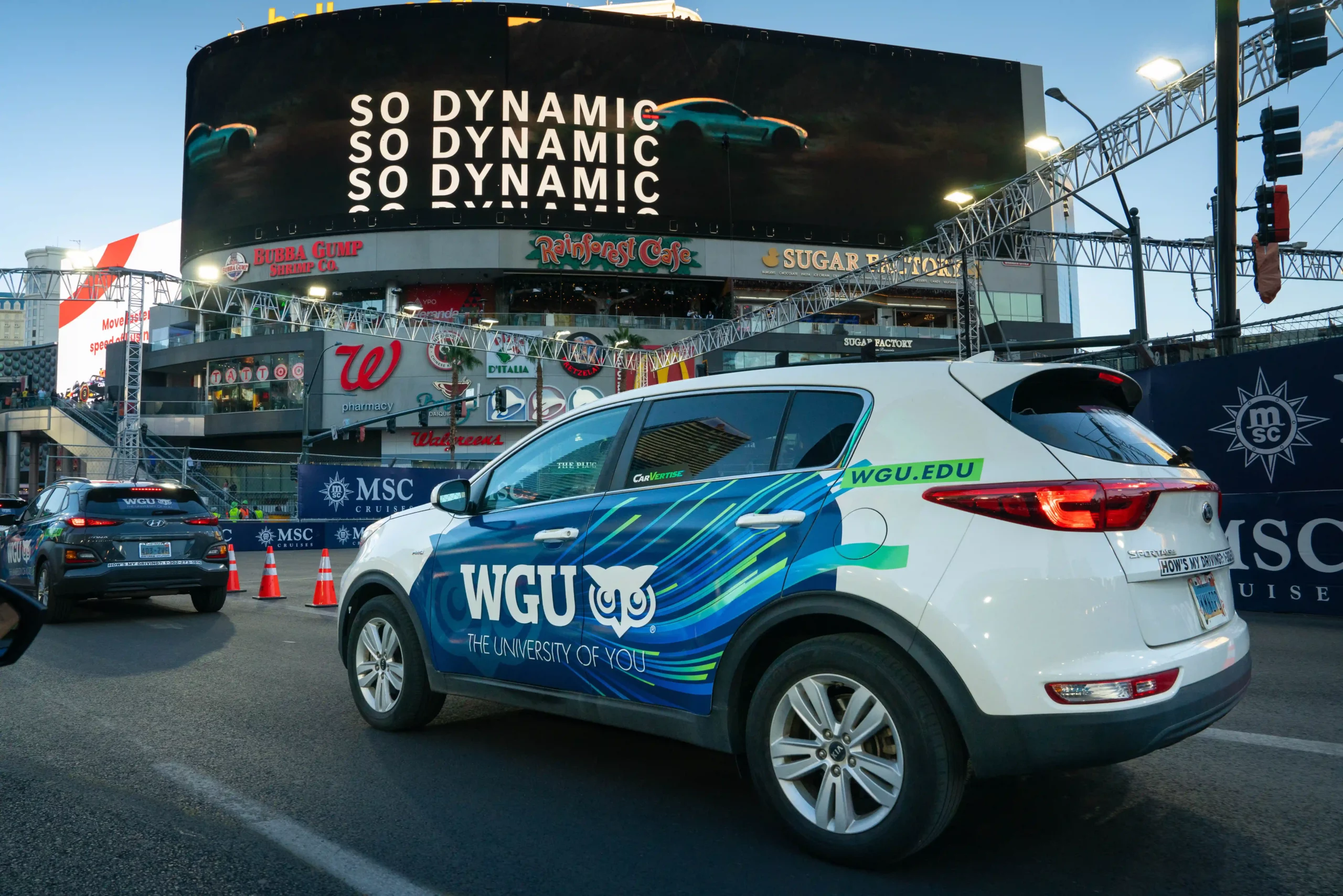
Conference marketing does not stop at the convention center doors. Attendees move between airports, hotels, sessions, dinners, entertainment venues, and private meetings, creating opportunities for brands to remain visible throughout the broader event experience.
Branded chauffeur services combine scheduled event transportation with custom-wrapped vehicles and optional in-vehicle brand elements. Brands can use these vehicles to transport clients, prospects, executives, speakers, creators, and VIPs while extending campaign visibility beyond the event venue.
In 2026, evaluating a provider requires more than comparing vehicle types and hourly rates. Brand and event marketers should consider creative production, event logistics, passenger experience, route planning, content capture, measurement, and the provider’s ability to coordinate the activation from planning through execution.
Key Takeaways: Evaluating Branded Chauffeur Services in 2026
- Evaluate branded chauffeur services as both transportation and experiential marketing.
- Look for integrated management across vehicle branding, logistics, passenger experience, content production, and reporting.
- Match the vehicle type and in-vehicle enhancements to the audience and campaign objective.
- Build routes around actual attendee movement rather than general traffic volume.
- Confirm how GPS data, impressions, passenger activity, and engagement will be measured.
- Request a complete scope covering production, staffing, transportation, content, measurement, and potential additional costs.
- Prioritize relevant event experience over generic claims about fleet size or luxury service.
What Are Branded Chauffeur Services?
Branded chauffeur services provide scheduled transportation in vehicles customized around a company, destination, product, or event campaign. Unlike a conventional black-car service, each vehicle functions as both transportation and a mobile brand experience.
The exterior may feature a full vehicle wrap, while the interior can be customized with campaign-specific elements. Depending on the program, these enhancements may include digital displays, custom lighting, branded amenities, product samples, promotional materials, music, giveaways, or other interactive experiences.
Carvertise’s Branded Chauffeur campaigns can support conferences, corporate events, client dinners, product launches, premieres, festivals, influencer activations, and other VIP experiences. Routes and schedules can be organized around priority destinations such as airports, hotels, convention centers, restaurants, meeting locations, and off-site brand events.
Why Are Brands Using Branded Chauffeur Services at Conferences?
Most conference sponsorships are concentrated inside a fixed venue. Booths, banners, lounges, and digital displays reach attendees while they are on-site, but that visibility often ends when they leave for dinner, return to their hotels, or travel to another event.
Branded chauffeur services extend the campaign into those transitional moments. Vehicles can meet attendees at one event touchpoint, transport them through the host city, and deliver them to their next destination within a coordinated brand experience.
The format can support several marketing objectives:
- Extend brand visibility beyond the exhibit floor
- Provide transportation for clients, prospects, executives, and VIPs
- Connect separate conference activities into one coordinated experience
- Generate visibility around convention, hotel, dining, and entertainment districts
- Create photography, video, and social content
- Give passengers more time to engage with the brand
- Strengthen client hospitality and relationship-building efforts
The greatest value comes when transportation, creative, routes, hospitality, and content all support the same campaign objective.
How Do Branded Chauffeur Services Differ From Standard Event Transportation?
Standard event transportation is primarily designed to move passengers safely and efficiently between locations. Branded chauffeur services must accomplish that operational goal while also delivering a coordinated marketing and guest experience.
Standard Event Transportation
A conventional transportation provider will usually focus on:
- Vehicle availability
- Pickup and drop-off scheduling
- Passenger capacity
- Driver coordination
- Hourly or daily transportation costs
This may be sufficient when transportation is purely functional.
Branded Chauffeur Services
A branded chauffeur provider should also be able to address:
- Exterior vehicle branding
- In-vehicle experience design
- Campaign creative and production
- Brand and vehicle presentation
- Strategic event routes
- On-site activation support
- Photography, video, or social content
- Campaign documentation and reporting
Strong transportation operations do not automatically translate into strong experiential marketing. The provider must understand how logistics, creative execution, passenger experience, and content affect the way the brand is perceived.
What Criteria Should You Use to Evaluate a Branded Chauffeur Provider?
Brand marketers should evaluate providers across seven areas: event execution, creative capabilities, passenger experience, content production, route strategy, measurement, and scope transparency.
1. Event and Conference Execution
Conference transportation involves more complexity than a standard point-to-point reservation. Sessions run late, attendee schedules change, traffic patterns shift, and venue access may be restricted.
Ask how the provider coordinates vehicles during active event periods. Determine whether the campaign includes a dedicated account manager, on-site support, or a dispatch process for handling real-time changes.
The provider should be able to explain:
- Who manages the activation on-site
- How passengers reserve or request rides
- How drivers receive schedule updates
- How vehicle locations are coordinated
- What happens when event schedules change
- How delays and service disruptions are handled
- Who communicates with the brand or agency during the activation
Do not accept a vague promise that the campaign will be “fully managed.” Request an activation plan that assigns responsibility for each part of the experience.
2. Exterior and Interior Creative Capabilities
The vehicle is one of the campaign’s most visible creative assets. Its design should remain recognizable from multiple angles, at different distances, and while the vehicle is in motion.
Review examples of previous vehicle wraps and event activations. Consider installation quality, brand consistency, message clarity, and whether the creative works on the specific vehicle model being proposed.
Depending on the campaign, interior elements may include digital displays, custom lighting, branded amenities, product samples, swag, promotional materials, or other passenger experiences.
Ask the provider:
- Who designs the exterior wrap?
- Who manages brand and legal approvals?
- What interior elements are available?
- Who sources and installs those elements?
- How are vehicles inspected before deployment?
- What happens if a wrap or interior element is damaged?
- When will the brand receive final vehicle photos or proof of installation?
The finished vehicle should feel intentionally designed around the campaign, not like a standard car with temporary branding added at the last minute.
3. Vehicle and Passenger Experience
The vehicle type should match the audience and purpose of the activation. Executive transportation for investors may require a different experience from attendee transportation at a consumer launch.
Evaluate vehicle condition, passenger capacity, luggage requirements, accessibility needs, climate control, and the amount of interior space available for customization.
The passenger journey should also be planned intentionally. Consider what attendees will see, hear, receive, or interact with during the ride. Every element should support the campaign instead of cluttering the vehicle with disconnected branding.
Personalization can be effective, but it should remain appropriate for the audience. Branded materials, destination guides, product demonstrations, digital content, or useful amenities will usually deliver more value than promotional items added without a clear purpose.
4. Content Capture and Social Amplification
For product launches, premieres, festivals, and creator-led brand events, the vehicle can also become part of the campaign’s content strategy. Influencers, creators, and brand partners can be transported between hotels, venues, dinners, and private activations while generating arrival moments, behind-the-scenes coverage, and social content.
B2B conference campaigns can use a similar approach to document executive transportation, client hospitality, booth-adjacent activity, and the brand’s presence throughout the host city.
Available content services may include professional photography, videography, social-ready edits, campaign recap videos, or sizzle reels. These deliverables should be confirmed during campaign planning because availability, production timelines, usage rights, and costs may vary.
Ask the provider:
- Is professional photography or videography available?
- Can the campaign include a recap video or sizzle reel?
- Are vertical, social-ready formats included?
- How quickly will edited assets be delivered?
- Who owns the final content?
- Are raw photos or video footage included?
- Are passenger releases or filming permissions required?
- Can the provider coordinate with the brand’s agency or content team?
Content production should be included in the campaign scope before launch rather than treated as an informal event-day addition.
5. Route and Deployment Strategy
Branded chauffeur services should connect the locations that matter most to the event audience.
These may include:
- Convention centers
- Conference hotels
- Airports and transportation hubs
- Client dinners
- Sponsor events
- Entertainment districts
- Sporting venues
- Private meetings
- Product demonstrations
- Evening receptions
Ask the provider to develop a route plan based on attendee behavior, event schedules, anticipated traffic, and venue access.
Vehicles can also generate exterior visibility between passenger trips or while positioned near high-value locations. Any stationary placement should be coordinated with the venue and comply with local parking, security, and permitting requirements.
A route plan should not be based only on where traffic is heaviest. It should prioritize places where the intended audience is most likely to see or use the service.
6. Measurement and Reporting
Branded chauffeur measurement should begin with a clear definition of what the campaign is expected to accomplish.
There are three useful measurement categories.
Campaign Delivery
These metrics confirm whether the activation was delivered as planned:
- Number of vehicles deployed
- Hours of operation
- Completed rides
- Passenger volume
- Scheduled destinations served
- Deployment or route records
- Service interruptions
Passenger Engagement
These metrics indicate how attendees interacted with the experience:
- QR code scans
- Landing-page visits
- Promotional materials distributed
- Content views
- Survey responses
- Social media mentions
- Photos or videos generated
- Guest feedback
Media Exposure
Mobile advertising metrics may include estimated impressions, geographic coverage, time in priority areas, and route-based exposure reporting.
Marketers should ask how each estimate is calculated. GPS data can verify where and when a vehicle traveled, but it does not independently prove how many people saw the vehicle. Any impression reporting should include a documented methodology and the data sources used to produce the estimate.
Do not accept “measurable” as a complete answer. Confirm exactly what the provider will report, how the data will be collected, and when the final report will be delivered.
7. Scope, Pricing, and Responsibilities
Branded chauffeur pricing involves more than the transportation rate. A complete proposal may include:
- Number and type of vehicles
- Campaign duration and activation days
- Daily service hours
- Creative development
- Wrap production, installation, and removal
- Vehicle sourcing
- Chauffeur services
- Event staffing and logistics
- Interior enhancements
- Branded merchandise or passenger amenities
- Photography, videography, or sizzle reels
- Parking and tolls
- Reporting and measurement add-ons
Campaign scopes should identify:
- What is included
- What is optional
- What the client must supply
- Which costs may change
- Which expenses require advance approval
- What happens if the event schedule expands
- Who is responsible for venue coordination
- Cancellation and change terms
- Content ownership and usage rights
- Final reporting and content-delivery timelines
What Questions Should You Ask a Branded Chauffeur Provider?
A structured vendor conversation will reveal whether the provider understands both transportation and event marketing.
Ask these questions before requesting a final proposal:
- Have you managed branded transportation for similar events?
- Can you share examples of past campaigns?
- Who handles the vehicle design, wrapping, and removal?
- What vehicle and interior branding options are available?
- Who manages the vehicles and drivers during the event?
- Will we have a dedicated event-day contact?
- How do you handle schedule changes or delays?
- Are any permits or venue approvals required?
- How will guests book or request rides?
- What reporting is included?
- How do you calculate estimated impressions?
- What happens if a vehicle becomes unavailable?
- How much lead time is required?
- What is included in the total price?
- What will our team be responsible for providing or managing?
A capable provider should be able to answer these questions with specific processes, not generic claims about service quality.
How Should You Measure the ROI of Branded Chauffeur Services?
The ROI of a branded chauffeur campaign should reflect its transportation, experiential, content, and media value.
Begin with the campaign’s primary objective and determine how rides will be requested and documented. Guest booking records, completed rides, passenger names, company information, and contact details can help brands understand who used the service and whether it reached priority clients, prospects, executives, creators, or other stakeholders.
Any personal information should be collected with appropriate notice and consent, and the provider should clearly explain what passenger data will be available after the campaign.
Transportation and Guest Value
Measure the service and audience reached:
- Guest bookings or ride requests
- Completed rides
- Passenger names and company affiliations, where permitted
- Passenger contact information, where collected with consent
- Number of priority clients, prospects, or VIPs transported
- Pickup and drop-off locations
- Priority destinations served
- Cost per completed ride
- Cost per passenger
- Schedule fulfillment
- Guest feedback or satisfaction
Experiential Value
Measure how passengers engaged with the brand during and after the ride:
- Time spent within the branded vehicle
- QR code scans and landing-page visits
- Product demonstrations or sampling
- Branded materials distributed
- Survey responses and guest feedback
- Photos, videos, or social posts generated
- Follow-up actions taken by clients or prospects
Media Value
Where exterior media reporting is included, evaluate:
- Estimated exterior impressions
- Geographic and route coverage
- Time spent near priority venues
- Deployment within selected event zones
- Cost per estimated impression
Estimated impressions should be reviewed alongside completed rides, passenger information, engagement activity, and content performance. Although a Branded Chauffeur campaign may reach fewer people than a broad awareness campaign, it can provide extended access to high-value clients, prospects, decision-makers, speakers, creators, and other priority guests.
Real-World Example: Visit Tampa Bay’s Branded Chauffeur Activation
At the 2024 Destinations International Annual Convention in Tampa, Carvertise deployed six luxury vehicles wrapped in Visit Tampa Bay branding. The vehicles provided complimentary transportation to multiple conference-related events, including an activation at the Florida Aquarium.
The experience continued inside the vehicles. Carvertise incorporated branded giveaways, destination marketing guides, promotional videos displayed on iPads, a curated playlist, and blue interior lighting that coordinated with the campaign design. Client fulfillment specialists were also present on-site to dispatch vehicles and support the activation.
The campaign illustrates what brand marketers should expect from an integrated branded chauffeur program:
- The exterior creative generated visibility around the host city.
- The service addressed an actual attendee transportation need.
- The interior gave passengers more time to engage with the destination.
- Branded content and amenities reinforced the campaign message.
- On-site coordination connected the creative concept with event execution.
Carvertise has since used the format in other event-based campaigns, including an Adrian Award-winning activation developed with Visit Pasadena and Madden Media. That campaign transported attendees between hotels, restaurants, entertainment areas, tailgate locations, and game-day activations using fully wrapped vehicles and immersive interiors.
What Common Mistakes Should Event Marketers Avoid?
Selecting a Provider Based Only on Transportation Cost
Branded chauffeur services require creative production and activation management in addition to transportation. The least expensive vehicle quote may not represent the best overall campaign value.
Treating the Wrap as an Afterthought
Vehicle creative must be adapted to the dimensions, doors, windows, curves, and viewing angles of the selected model. Starting creative too late can weaken the design or delay production.
Overlooking the Interior Experience
The exterior reaches people around the vehicle. The interior reaches the passengers who have chosen to engage with the service. Ignoring the interior leaves one of the format’s most valuable advantages unused.
Planning Routes Without Studying the Event
Generic city routes may generate traffic exposure but miss the locations most relevant to attendees. Build the deployment plan around the conference schedule, hotel blocks, event venues, and offsite activity.
Using Undefined Measurement Language
Terms such as “impressions,” “reach,” and “engagement” can mean different things across providers. Define each metric in the campaign scope and request the methodology behind any modeled result.
Waiting Too Long to Begin Production
Vehicle sourcing, creative approval, wrap production, installation, venue coordination, and route planning all require time. Begin planning once the event city, dates, and campaign objective are known rather than waiting for the full conference schedule to be finalized.
What Makes Carvertise Branded Chauffeur Different?
Carvertise developed Branded Chauffeur as an event-anchored experiential marketing format that combines premium transportation with exterior visibility and a customizable passenger experience.
Brands can select the event market, identify important offsite destinations, work with Carvertise’s creative team on the vehicle design, and choose interior elements such as digital signage, lighting, branded amenities, and promotional materials.
The service is designed to connect the different locations surrounding conferences and high-profile events. Instead of limiting the campaign to a booth or fixed placement, Branded Chauffeur can carry the brand between the exhibit floor, hotels, dinners, meetings, and entertainment venues.
Carvertise’s previous activations also demonstrate the importance of on-site execution. For the Visit Tampa Bay launch, fulfillment specialists were present to coordinate dispatch and support the passenger experience.
For marketers, the relevant evaluation question is whether a provider can manage the activation as one coordinated program. Transportation, creative, event logistics, and passenger experience should reinforce each other from the first pickup through the final drop-off.
FAQs About Branded Chauffeur Services
What are branded chauffeur services?
Branded chauffeur services provide scheduled event transportation in vehicles customized with exterior advertising and, in some cases, branded interior experiences. They are commonly used to transport clients, attendees, speakers, executives, and VIPs during conferences, corporate events, product launches, and other high-profile activations.
How are branded chauffeur services different from limousine services?
A limousine or black-car service focuses primarily on passenger transportation. Branded chauffeur services combine transportation with exterior advertising, creative production, interior branding, event route strategy, and campaign execution.
What parts of a chauffeur vehicle can be branded?
Options can include a full exterior vehicle wrap, digital displays, interior lighting, branded amenities, promotional materials, product samples, destination guides, music, and passenger giveaways. Available elements will depend on the vehicle and provider.
How far in advance should you book branded chauffeur services?
Lead time depends on the number of vehicles, market, creative complexity, interior customization, and event requirements. Begin vendor conversations as soon as the event dates and city are confirmed. The final schedule can often be refined later, but creative production and vehicle sourcing should not be left until the last minute.
Can branded chauffeur campaigns be measured?
Yes, but measurement varies by activation. Marketers can track campaign delivery, completed rides, passenger volume, engagement activity, geographic coverage, social content, and estimated media exposure. Confirm the exact reporting package and methodology before contracting.
What events are best suited to branded chauffeur services?
The format works well for conferences, trade shows, corporate gatherings, VIP dinners, sporting events, destination marketing activations, product launches, entertainment events, and programs where attendees travel between multiple locations.
Can branded chauffeur services transport attendees beyond VIPs?
Yes. The audience can include clients, prospects, speakers, employees, influencers, partners, or general attendees. The appropriate passenger group depends on the campaign objective, available vehicle capacity, and event budget.
What should be included in a branded chauffeur proposal?
The proposal should specify vehicles, operating hours, service area, creative production, wrap installation and removal, interior customization, driver coordination, event staffing, passenger access, reporting, contingency planning, and all additional costs.
Choose a Branded Chauffeur Partner That Can Manage the Full Experience
The right provider should be able to coordinate vehicle branding, passenger transportation, event logistics, in-vehicle experiences, content capture, and campaign reporting as one integrated program.
Carvertise develops Branded Chauffeur campaigns for conferences, corporate events, client hospitality programs, product launches, premieres, festivals, and other event activations. Each program can be customized around your market, audience, schedule, passenger experience, content needs, and measurement goals.
Planning an upcoming event? Speak with a Carvertise specialist about building a Branded Chauffeur campaign around your audience and objectives.