

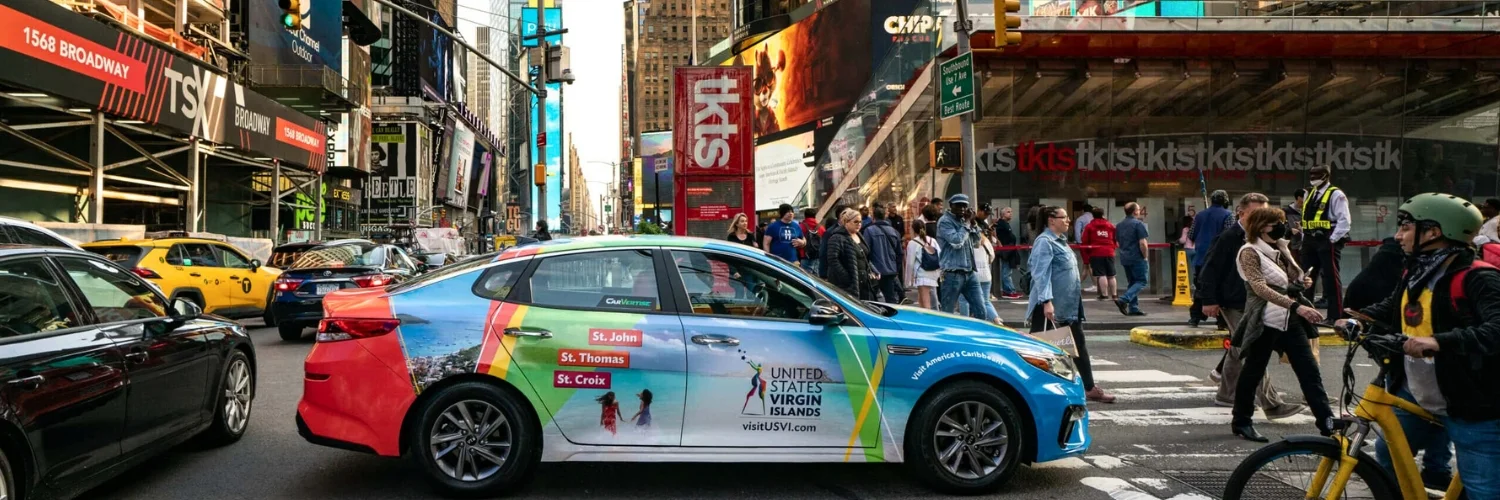
Spokane’s position as Eastern Washington’s hub creates concentrated traffic patterns along I-90, Division Street, and Highway 2 that make traditional billboards tempting. Static placements capture commuters traveling between Spokane Valley, downtown, and North Spokane—delivering thousands of daily impressions at predictable costs.
A dual approach combining traditional Spokane billboards with mobile billboards through Carvertise delivers maximum exposure by covering both highway traffic and neighborhood-level reach. Static placements maintain presence on major commuter routes while wrapped vehicles circulate through residential areas, commercial districts, campus zones, and entertainment corridors where your actual customers live, work, study, and spend money.
Ready to maximize your Spokane exposure beyond either billboards or mobile advertising alone? Contact Carvertise to build a dual approach that leverages traditional placement reach while adding neighborhood-level targeting, flexibility, and real-time optimization that static billboards cannot provide.
Why Dual Approaches Outperform Single-Channel Outdoor Advertising
Understanding the complementary strengths of static and mobile outdoor advertising reveals why combined strategies deliver superior results.
Coverage Multiplication Across Different Contexts
Traditional Spokane billboards excel at reaching specific high-traffic corridors repeatedly. Your I-90 placement near downtown captures thousands of daily commuters. But that same commuter sees your billboard only on that specific route during their predictable commute pattern.
Mobile billboards add exposure in entirely different contexts: the same commuter encounters your wrapped vehicle while shopping at the Spokane Valley Mall on Saturday, sees it again outside a downtown restaurant Wednesday evening, and notices it parked near their neighborhood coffee shop Sunday morning.
This context multiplication creates much stronger memory formation than single-location repeated exposure. The brain processes each context as distinct, maintaining attention and building familiarity without habituation. Your I-90 billboard might become invisible background after the tenth commute, but the wrapped vehicle appearing in varied settings remains attention-worthy.
Highway Reach + Neighborhood Targeting
Static billboards deliver broad reach but poor targeting. Your Division Street placement reaches everyone traveling that corridor regardless of whether they’re your customer demographic. You’re paying for thousands of wasted impressions daily on people who’ll never buy your product or service.
Mobile billboards add behavioral targeting within Spokane’s specific zones. Need to reach Gonzaga students? Wrapped vehicles circulate through campus-adjacent areas and popular student spots. Want affluent South Hill families? Coverage emphasizes the neighborhood’s shopping centers and commercial districts. Seeking downtown professionals? Lunch hour presence near office buildings and evening coverage in restaurant districts.
This dual approach ensures you maintain broad highway presence while adding precision targeting that dramatically improves impression quality and conversion rates.
Static Presence + Dynamic Optimization
Traditional billboards lock you into fixed locations for 6-12 month contracts. If your placement underperforms, you’re committed to continued spending with no ability to adjust.
Mobile billboards add flexibility and optimization. GPS tracking shows which Spokane neighborhoods and times of day generate engagement. If South Hill coverage outperforms Spokane Valley, driver recruitment shifts accordingly. If weekend exposure drives better results than weekdays, routing adjusts to maximize high-performing windows.
This combination means your advertising budget includes both stable, predictable highway presence and dynamic, optimizable neighborhood coverage—reducing overall risk while maximizing upside potential.
Frequency Building Through Multi-Channel Exposure
Effective advertising requires frequency—multiple exposures before consumers act. Single-channel approaches struggle to achieve meaningful frequency without overwhelming budgets.
A dual approach achieves frequency economically. Someone sees your I-90 billboard Monday morning (exposure 1), encounters your wrapped vehicle at a gas station Tuesday (exposure 2), notices it in a parking lot Thursday (exposure 3), sees the billboard again Friday (exposure 4), and spots the wrap outside a restaurant Saturday (exposure 5).
Five exposures across two weeks through varied contexts creates much stronger memory and action than five exposures to the same static billboard, which habituation will cause the brain to ignore after the second or third viewing.
Case Study: Rita’s Water Ice Multi-Location Event-Driven Campaign
Rita’s Water Ice Philadelphia campaign demonstrates how mobile billboards drive measurable store visits across distributed locations by reaching customers during active decision-making periods throughout their daily routines.
Campaign Strategy and Execution
Rita’s Water Ice launched rideshare vehicles in Philadelphia for 8 weeks, strategically targeting key city areas and major events including concerts and professional sporting events. The strategy recognized that impulse treat purchases happen throughout people’s daily routines—not just during highway commutes—and concentrated mobile billboard presence when entertainment activity and out-of-town visitors peaked.
The wrapped vehicles featured Rita’s distinctive branding with vibrant, appetizing imagery designed to trigger immediate cravings and drive store visits. Rideshare drivers naturally circulated through entertainment districts during events, residential neighborhoods on weekends, and commercial areas during shopping hours—exactly where potential customers were making spontaneous dining and treat decisions.
Carvertise partnered with StreetMetrics to track actual store visits to Rita’s 125 locations following exposure to wrapped vehicles, measuring real customer behavior across a distributed retail footprint.
Verified Results
The campaign produced exceptional, measurable retail traffic demonstrating mobile billboards’ effectiveness:
74,000+ unique devices exposed to Rita’s Water Ice cars during the Carvertise campaign.
779+ visitors driven to Rita’s Water Ice locations during the Carvertise campaign.
With nearly 4 million impressions reaching 800,000 unique individuals over 8 weeks, the campaign achieved approximately 5x frequency—meaning the average exposed person encountered Rita’s wrapped vehicles five times. This repeated exposure built familiarity and triggered action, with StreetMetrics verifying actual store visits following mobile billboard exposure.
For a multi-location retailer like Rita’s with 125 stores across Philadelphia, these results demonstrate mobile billboards’ effectiveness at driving traffic to wherever customers encounter your business—not just to one location near your advertising placement.
Application to Spokane’s Dual Approach Strategy
Rita’s success reaching Philadelphia customers throughout their routines while concentrating on event-driven surge periods provides a model for Spokane’s dual approach.
Static Spokane billboards might promote brand awareness: “Rita’s Water Ice—Now in Spokane Valley.” Mobile billboards add location-specific targeting and event-driven surge coverage: wrapped vehicles concentrate near Spokane Arena during concerts and Spokane Indians games, increase presence downtown during Hoopfest, and circulate through neighborhood commercial districts on summer weekends when families seek treats.
The 779+ verified store visits across 125 locations prove mobile billboards drive traffic to distributed retail networks. For Spokane businesses with multiple locations (restaurants, retail chains, service providers), this means mobile advertising complements your static billboard awareness-building by driving actual foot traffic wherever customers encounter your business throughout Spokane.
The event-driven timing also demonstrates optimization opportunities unavailable with static placements. Time mobile billboard surges around Bloomsday (May), Hoopfest (June), Spokane County Interstate Fair (September), or holiday shopping periods while maintaining year-round static billboard presence for consistent awareness.
Strategic Implementation: Building Your Spokane Dual Approach
Effective dual approach strategies require coordinating static and mobile elements to maximize complementary strengths.
Static Billboard Role: Use traditional placements for brand awareness, broad reach, and consistent presence. I-90 near downtown reaches commuters. Division Street captures north-south traffic. Highway 2 targets Spokane Valley and Airway Heights traffic. These placements build familiarity and establish market presence.
Mobile Billboard Role: Add neighborhood targeting, behavioral precision, and event-driven optimization. Wrapped vehicles reach Gonzaga students, South Hill families, downtown professionals, Perry District residents, and Kendall Yards demographics that static placements miss. Coverage concentrates during high-value windows: lunch hours, evening dining decisions, weekend shopping periods, and major Spokane events.
Message Coordination: Static billboards can carry broader brand messages or primary value propositions. Mobile wraps can feature specific offers, location information, or calls-to-action that drive immediate response. Or both channels can carry consistent branding for maximum frequency and recognition.
Budget Allocation: Many Spokane businesses find 60/40 or 70/30 splits (static/mobile or mobile/static depending on business model) optimize reach and targeting. Static billboards provide baseline presence. Mobile adds flexibility, targeting, and optimization for incremental budget.
Performance Measurement: Traditional billboard metrics (estimated impressions, traffic counts) combine with Carvertise’s GPS-verified coverage data, neighborhood exposure analytics, and attribution tracking to provide comprehensive performance visibility impossible with static placements alone.
Launch Your Spokane Dual Approach Campaign
Carvertise enables Spokane businesses to build comprehensive outdoor advertising strategies combining traditional billboard reach with mobile billboard targeting and flexibility.
Initial consultation assesses existing billboard placements (if any) and identifies gaps in coverage, targeting opportunities, and optimization potential. Campaign design creates mobile wraps coordinating with or complementing static billboard creative for consistent branding or differentiated messaging based on strategy.
Driver recruitment focuses on Spokane neighborhoods, demographic zones, and traffic patterns that traditional billboard placements underserve—ensuring mobile elements add incremental value rather than duplicating existing coverage.
GPS tracking provides performance visibility across both channels, showing how static highway presence and mobile neighborhood coverage combine to maximize Spokane market penetration and customer reach.
Contact Carvertise for a Spokane dual approach proposal including current billboard assessment, mobile billboard targeting recommendations, creative coordination strategies, and budget allocation modeling that maximizes total outdoor advertising ROI.
Frequently Asked Questions
Should I replace my existing Spokane billboards with mobile advertising?
Not necessarily. Dual approaches often outperform either channel alone. Existing billboards may provide valuable highway presence that mobile advertising complements with neighborhood targeting rather than replaces.
Can mobile billboard creative coordinate with existing static billboard designs?
Yes. Wraps can feature consistent branding, messaging, and visual elements that reinforce static billboard exposure, or use differentiated approaches (brand awareness vs. specific offers) based on strategic objectives.
What’s the timeline for adding mobile billboards to existing outdoor advertising?
Campaigns launch within 2-4 weeks. Design approval takes 3-5 days, driver recruitment 1-2 weeks, and wrap production/installation 5-7 days—allowing rapid deployment alongside existing placements.
How many vehicles complement typical Spokane billboard coverage?
This depends on existing placement locations and business objectives. Businesses with 2-3 static billboards often add 6-10 wrapped vehicles for comprehensive coverage. Those with extensive static presence might add 12-15 vehicles for maximum market saturation.
Can mobile billboard budgets scale seasonally while maintaining year-round static presence?
Yes. Many Spokane businesses maintain consistent static billboard presence while scaling mobile campaigns up during peak seasons (summer tourism, holiday shopping, Hoopfest/Bloomsday) and down during slower periods for budget efficiency.