

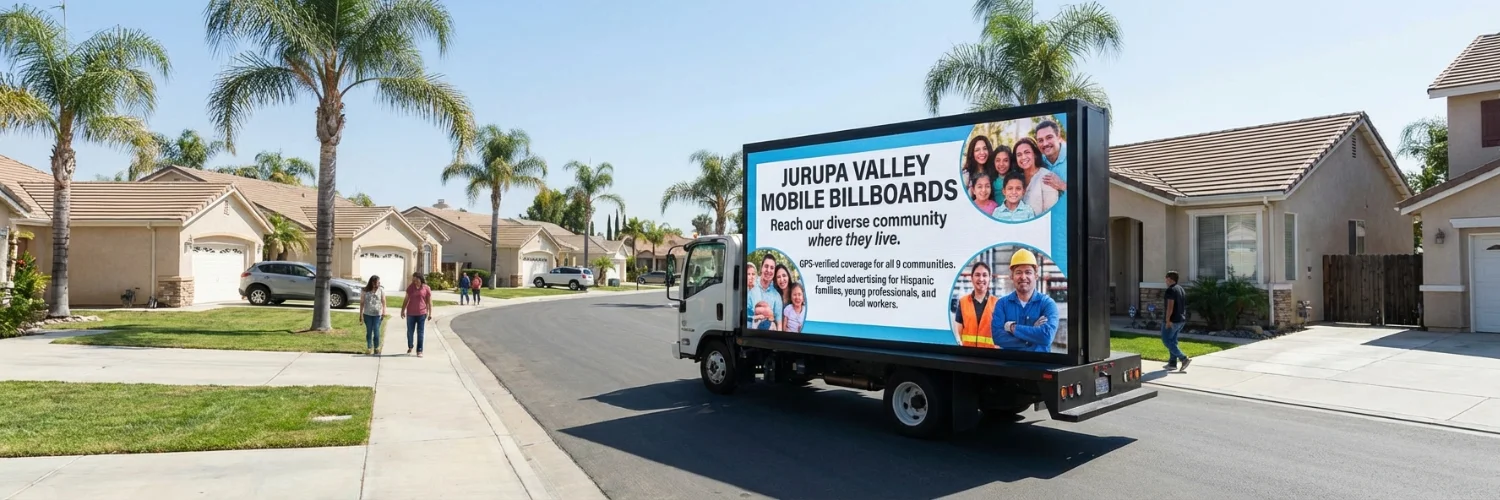
Billboard advertising in sprawling Jurupa Valley creates unique challenges that traditional static placements struggle to solve. With over 100,000 residents scattered across 9 distinct communities spanning 44 square miles, a single highway billboard can’t always reach the workers in Glen Avon, shoppers in Rubidoux, or manufacturing professionals throughout this diverse Riverside County city.
That’s where modern mobile billboard solutions transform outdoor advertising effectiveness. Vehicle advertising delivers comprehensive community coverage with GPS-verified performance data, flexible deployment, and proven results that static signs simply cannot match. Understanding mobile vs. static performance helps optimize your advertising investment across Jurupa Valley’s unique geographic and demographic landscape.
Why Jurupa Valley’s Geography Challenges Traditional Billboard Advertising
Sprawling Communities Across 44 Square Miles
Jurupa Valley’s expansive layout creates advertising challenges that single-location billboards cannot address effectively. Traditional billboards concentrate along major corridors like Interstate 15 and State Route 60, capturing commuter traffic but missing residential communities where residents actually live, shop, and make purchasing decisions. Areas like Glen Avon, Rubidoux, and Mira Loma remain largely unreachable through conventional outdoor advertising placement.
Diverse Demographics Require Targeted Approach
With a 71.4% Hispanic population, median age of 33.8 years, and diverse employment across construction, retail trade, and manufacturing, effective advertising must reach multiple community segments.
The city’s median household income of $96,190 indicates substantial purchasing power, but traditional highway placements miss neighborhood-level targeting where these affluent residents make daily purchasing decisions.
Static Billboard Limitations in Jurupa Valley Markets
Limited Geographic Coverage
Highway-focused billboard placement creates significant gaps in audience reach throughout Jurupa Valley’s residential and commercial areas. Static signs positioned along I-15 and SR-60 corridors capture pass-through traffic but fail to penetrate the neighborhoods where residents live and conduct business.
Premium highway locations command higher rates while delivering limited local relevance. Billboard costs in Jurupa Valley vary significantly by placement, with prime highway positions often exceeding small business budgets while missing the community-level targeting that drives local purchasing behavior.
Investment Challenges and Rigid Contracts
Traditional billboard advertising often involves upfront commitments and fixed terms. Standard contracts typically include four-week minimums, with many vendors preferring six- to twelve-month agreements. Production expenses usually range from $500 to $2,000, depending on the creative requirements.
Monthly placement fees for high-visibility locations can exceed $5,000, which may limit how broadly some businesses can allocate their advertising budgets. These formats also prioritize single geographic placements, which may or may not align with a brand’s broader outreach goals.
Performance measurement for static billboards generally uses estimated traffic counts rather than verified exposure metrics. As a result, assessing return on investment and making mid-campaign adjustments can be less precise compared to formats that offer real-time data.
Mobile Billboard Advantages: The Carvertise Solution
Comprehensive Community Coverage
Mobile vehicle advertising transforms Jurupa Valley’s geographic challenges into opportunities through comprehensive community penetration. Wrapped vehicles driven by local residents travel through all 9 communities daily, creating organic brand presence where traditional billboards cannot reach.
Each vehicle generates 30,000-70,000 daily impressions while moving through residential areas, shopping centers, business districts, and community gathering spaces. This mobility ensures brand visibility across Jurupa Valley’s complete demographic spectrum rather than limited highway exposure.
Vehicle wraps integrate naturally into daily community life, appearing at school pickup areas, grocery stores, local businesses, and neighborhood events where residents make purchasing decisions.
Superior Performance Metrics
Mobile advertising delivers measurable performance advantages compared to static placements. Industry data shows 497% average ROI for outdoor advertising, with mobile formats consistently outperforming static alternatives through enhanced targeting and measurement capabilities.
According to a 2023 analysis by the OAAA and Solomon Partners, out-of-home advertising (OOH) generally delivers significantly higher recall among consumers compared with many other media channels (TV, streaming, print, online, radio).
GPS tracking provides verified exposure data instead of estimated traffic projections, enabling real-time campaign optimization and accurate ROI calculation.
Cost-Effectiveness Analysis: Mobile vs. Static
Traditional Billboard Investment Requirements
Static billboard advertising often requires multiple cost commitments that vary widely depending on location, size, and traffic volume. Monthly rental fees can range from a few hundred dollars in lower-traffic or rural areas to several thousand dollars in more visible corridors, with many small and mid-sized markets falling in the $1,500–$5,000+ range.
Advertisers may also need to budget separately for design, printing, and installation, as production costs, such as creative development, vinyl printing, and mounting can add several hundred to a few thousand dollars to the overall spend.
Visibility and value depend heavily on local traffic patterns, available inventory, and demand, which means the effective reach can vary significantly from one placement to another. This makes static billboards a potentially less flexible and more variable investment compared with mobile or digital formats that offer broader coverage or real-time targeting.
Mobile Advertising Economics
Vehicle wrap campaigns generate impressions at $0.48 CPM compared to traditional billboard rates of $2-$7 CPM, delivering superior cost-effectiveness.
Campaigns scale from single vehicles to larger fleets without long-term contractual obligations. SWARM deployments can concentrate multiple vehicles during specific promotional periods, creating temporary saturation without permanent financial commitments.
Mobile advertising flexibility enables budget optimization based on actual performance data rather than pre-campaign estimates.
Strategic Deployment for Jurupa Valley Success
Community-Specific Targeting
Mobile advertising enables precise geographic and demographic targeting throughout Jurupa Valley’s diverse communities. Route planning can focus on construction worker commute patterns, retail shopping areas, or specific cultural neighborhoods based on campaign objectives.
Morning deployment can target business districts and commuter routes, while evening coverage focuses on shopping centers and entertainment areas where residents gather after work. Weekend routing emphasizes recreational areas and family-oriented community spaces.
Event-based deployment allows brands to appear at local festivals, school events, community meetings, and seasonal gatherings where traditional billboards have no presence.
Integration with Business Development
Mobile campaigns can adapt to changing development patterns as new residential and commercial areas develop across the city’s expanding footprint.
Small business support through accessible advertising helps strengthen the local economy while building brand recognition throughout diverse community segments.
Performance Measurement and Optimization
Real-Time Analytics vs. Estimated Impressions
Mobile advertising provides verified performance data that traditional billboards cannot match. GPS tracking shows exact routes traveled, time spent in specific areas, and verified impression counts based on actual vehicle presence rather than traffic estimates.
Digital attribution through geofencing identifies mobile devices exposed to campaigns, enabling subsequent digital retargeting and conversion tracking. This integration bridges offline exposure with online engagement measurement.
Campaign optimization occurs in real-time based on performance data, allowing route adjustments, timing modifications, and geographic concentration adjustments without contract renegotiation.
ROI Tracking and Business Impact
Direct response measurement through dedicated phone numbers, QR codes, and promotional codes provides clear attribution from mobile billboard exposure to business outcomes. Local businesses can track foot traffic increases, sales spikes, and inquiry volume directly correlated with campaign deployment.
Brand awareness studies within specific Jurupa Valley communities demonstrate campaign impact on recognition, recall, and purchase intent across different demographic segments.
Performance transparency enables budget optimization and strategic planning for sustained advertising effectiveness.
Getting Started with Mobile Advertising in Jurupa Valley
Campaign Planning and Objectives
Successful mobile advertising begins with clear objective definition and target audience identification. Are you building brand awareness among construction workers? Driving foot traffic to retail locations? Reaching Hispanic families with specific cultural messaging?
Campaign planning considers Jurupa Valley’s unique characteristics: diverse demographics, scattered geography, economic development patterns, and community event schedules. Strategic deployment maximizes exposure during peak audience availability.
Budget allocation balances geographic coverage with frequency exposure, ensuring optimal brand recognition development across target communities.
Creative Strategy for Diverse Demographics
Effective mobile advertising creative addresses Jurupa Valley’s demographic diversity through culturally relevant messaging and visual design. Bilingual creative serves the 71.4% Hispanic population while maintaining broad appeal across all community segments.
Industry-specific messaging targets the construction, retail, and manufacturing workforce with relevant value propositions and calls-to-action. Visual design prioritizes bold, simple graphics readable from 500+ feet during brief viewing opportunities.
Community integration emphasizes local relevance through neighborhood-specific references, event sponsorships, and civic engagement that builds authentic connections.
Ready to Explore Jurupa Valley’s Mobile Advertising Opportunities?
Whether you’re supporting the growing construction workforce, targeting retail shoppers, or building brand awareness among this diverse community, mobile advertising delivers verified results across Jurupa Valley’s entire 44-square-mile footprint.
Carvertise combines local market knowledge with GPS-verified performance data, creative excellence, and flexible deployment that adapts to Jurupa Valley’s economic development and community rhythms. When you’re ready to reach this dynamic Riverside County market effectively, we’re ready to design campaigns that deliver measurable results. Contact Carvertise to get your Jurupa Valley advertising strategy moving forward.
Frequently Asked Questions
How much do billboards cost in Jurupa Valley?
Billboard costs vary by location and format, with highway placements commanding premium rates ranging $1,000-$5,000+ monthly. Mobile advertising offers more flexible pricing without long-term contracts, often delivering better cost-per-impression rates while reaching multiple communities throughout the city.
Which areas of Jurupa Valley are best for advertising?
Traditional billboards focus on I-15 and SR-60 corridors for highway visibility. Mobile advertising reaches all 9 communities including Glen Avon, Rubidoux, and Mira Loma neighborhoods where residents live and shop, providing comprehensive coverage static signs cannot achieve.
Can mobile advertising target specific Jurupa Valley demographics?
Yes. Route planning can focus on construction worker commutes, retail shopping areas, or specific cultural communities within the city’s diverse population. Morning, evening, and weekend deployment strategies target different audience segments effectively.
What’s the minimum commitment for mobile vs. static billboard campaigns?
Static billboards typically require 4-week minimums with 6-12 month preferred contracts plus production costs. Mobile campaigns offer flexible durations without rigid contracts, enabling responsive campaign adjustments based on performance data.
How do you measure mobile billboard effectiveness?
GPS tracking, geofencing, digital attribution, QR code scans, and direct response metrics provide comprehensive performance measurement. Real-time analytics enable campaign optimization while static billboards provide only estimated impression data.
Is mobile advertising suitable for small Jurupa Valley businesses?
Absolutely. Mobile campaigns scale from single vehicles to larger fleets, making professional advertising accessible to local businesses without requiring substantial upfront commitments or long-term contracts that static billboards demand.
How does mobile advertising reach Jurupa Valley’s Hispanic community?
Vehicles can target specific neighborhoods with bilingual messaging, appearing at community centers, shopping areas, cultural events, and family gathering spaces where traditional highway billboards have no presence or relevance.
What creative considerations work best for mobile campaigns?
Bold visuals readable from far away distances, minimal text (6-8 words maximum), and clear calls-to-action that bridge offline exposure to online engagement or direct business contact.
Can mobile billboards cover multiple Riverside County cities?
Yes. Campaigns can extend beyond Jurupa Valley to reach regional markets including Riverside, Corona, and surrounding areas while maintaining concentrated local presence where target audiences live and work.
How far in advance should I plan a mobile billboard campaign?
Mobile campaigns typically launch within 3-4 weeks from planning to deployment, significantly faster than static billboard booking timelines which often require 6-8 weeks advance notice for premium locations.
What ROI should I expect from Jurupa Valley mobile advertising?
Industry data shows 497% average ROI for outdoor advertising, with mobile formats often outperforming static placements due to superior targeting, measurement capabilities, and geographic flexibility that reaches diverse community segments effectively.